We have been here before: AI transformation and the Agile déjà vu
Most organisations are going to look back at their AI transformation the same way they look back at their Agile transformation: a lot of energy, a lot of spend, and a programme that delivered certificates rather than change.
That is the uncomfortable pattern forming right now. The vocabulary is different. The consultants are different. The urgency is higher. But the shape of the failure is almost identical to what happened with Agile adoption a decade ago. If you were in a delivery leadership role during that period, you should be feeling a strong sense of déjà vu.
The numbers are not the story. The pattern is.
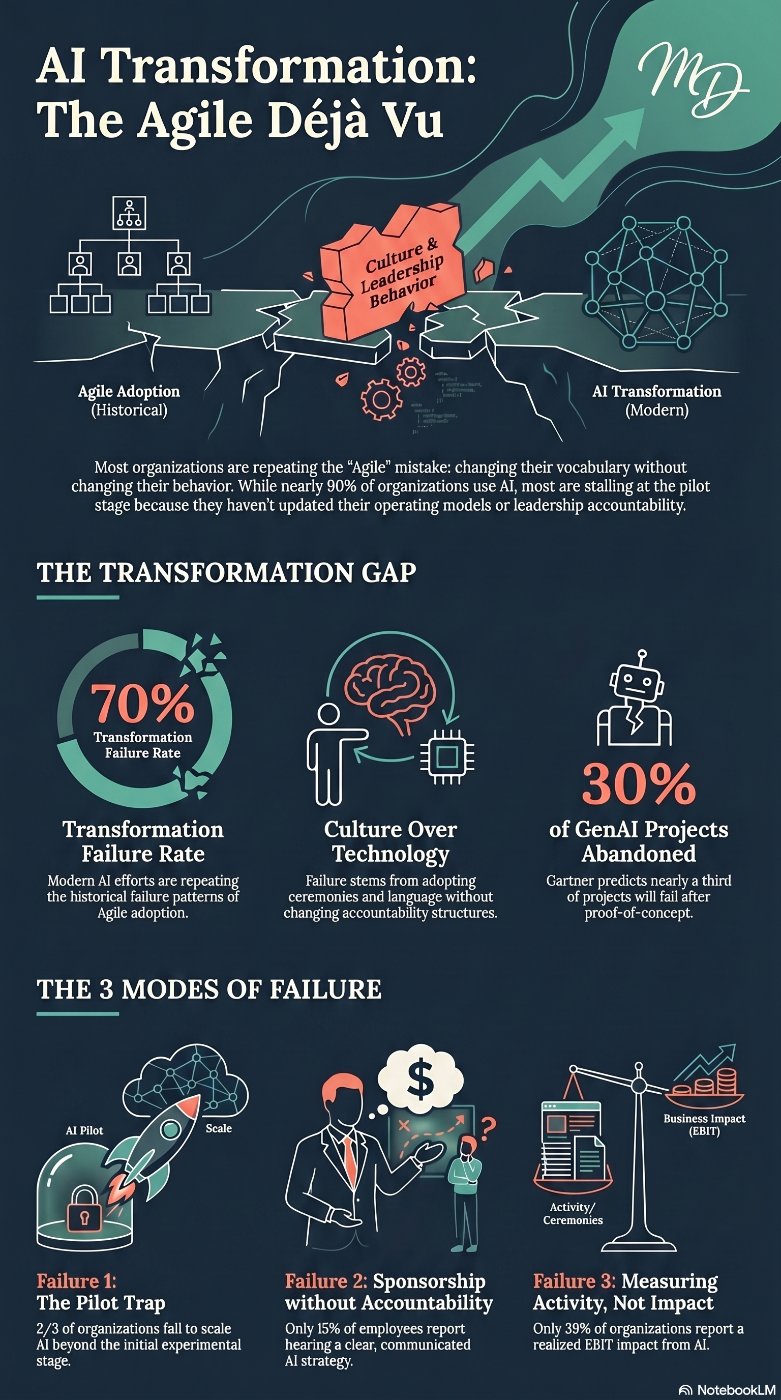
Nearly nine out of ten organisations now report using AI in at least one business function, yet most have not embedded it deeply enough into their workflows to realise material, enterprise-level benefits. [1] Meanwhile, Gartner has predicted that at least 30% of generative AI projects will be abandoned after proof of concept, citing poor data quality, inadequate risk controls, escalating costs, and unclear business value. [2]
Read those two sentences together. Near-universal adoption. Near-universal stall.
This is not a technology story. It is a leadership story. And it is one that should sound familiar.
Cast your mind back to roughly 2013 to 2016. Agile was sweeping through enterprise IT. Scrum Masters were being hired. Retrospectives were being scheduled. Executives were sponsoring Agile transformations with genuine conviction. A decade of research from BCG, McKinsey, and Harvard Business School tells a consistent story: approximately 70% of these transformation efforts fail. And the reasons have almost nothing to do with the technology itself. [4]
Organisations adopted the ceremonies without changing the culture, the frameworks without changing the leadership behaviours, and the language without changing the accountability structures. The same thing is happening now. The word "Agile" has been replaced with "AI." The transformation programme has been replaced with the AI strategy deck. And the pattern is repeating, despite the fact that this time there is a Chief AI Officer in the room.
That last point matters. Most Agile transformations did not even have a C-suite owner. AI transformation does. It has board approval, dedicated budget, and a named executive accountable for it. And it is still stalling at the same places. That tells you something important: the problem was never about how high up the organisation the mandate sat. It was about whether the organisation actually changed how it operates. It did not then. Most are not now.
Three failure modes that did not go away
Failure mode 1: The pilot trap
Approximately two-thirds of organisations remain in the experimenting or piloting phase and have not yet begun scaling AI across the enterprise. [1] Pilots succeed. Production fails. The bottleneck is not the technology. It is the organisation's inability to absorb the change the technology requires.
Agile transformations got stuck in exactly the same place. One team would go Agile. The rest of the organisation would stay waterfall. The Agile team would deliver faster and then get frustrated that nothing downstream could absorb what they were building. The transformation stalled at the boundary.
AI is doing the same. Strong proof of concept results run headlong into an operating model that has not been redesigned, governance that was not built for probabilistic outputs, and a risk function that has no framework yet for signing off on something that does not behave deterministically.
Failure mode 2: Sponsorship that is visible but not accountable
Only 15% of US employees report that their workplace has communicated a clear AI strategy. [5] That number sits at the workforce level. At the delivery team level, it is felt as being handed a mandate without the authority, the data access, or the organisational backing to execute it.
In every struggling Agile transformation I observed, the executive sponsor was enthusiastic at the launch and invisible six months later. The teams were left defending the methodology against a middle management layer that had not bought in and was not required to. The transformation became the delivery team's problem, not the organisation's.
AI transformation is following the same script. The board has approved the strategy. The case study has been commissioned. Somewhere in the middle of the organisation, a delivery team is trying to get a model into production while fighting for data access, legal sign-off, and a risk framework written before any of this existed. The gap between executive intent and organisational reality is the same gap that killed most Agile transformations. It is not a technology gap.
Failure mode 3: Measuring the wrong things
McKinsey's research finds that just 39% of organisations report any EBIT impact at the enterprise level from AI, despite near-universal adoption. [1] The majority are celebrating AI progress measured by pilot metrics: usage rates, model accuracy scores, features shipped.
Agile transformations fell into the same trap. Teams were declared successful when they achieved 100% of sprint goals. That sounds positive until you realise that teams were setting goals low enough to guarantee delivery, which defeated the purpose entirely. Velocity metrics replaced outcome metrics. Activity replaced impact.
Organisations reporting significant financial returns from AI are twice as likely to have redesigned end-to-end workflows before selecting modelling techniques. [5] The organisations actually capturing value started with the operating model, not the model. That is a leadership decision, not a technology one.
What this means if you are leading one of these programmes
The Agile analogy is useful not because it is pessimistic but because it is specific. It tells you exactly where the risk lives.
If your AI transformation is being led primarily by a technology team with occasional executive endorsement, it will stall at adoption. The people who need to change how they work are not in the room where the model is being built.
If your governance model was not designed for probabilistic outputs and iterative delivery, the model will get to UAT and stop. Gartner notes that integrating AI into legacy systems is often technically complex and disruptive, and recommends that in many cases, rethinking workflows from the ground up is the path to successful implementation. [3]
And if your leadership team is still treating AI as something the technology function delivers to the business, rather than something that requires the business to fundamentally change how it operates, you are in the same position as the executive in 2014 who approved the Agile transformation and then continued running quarterly waterfall reviews. The title on the door has changed. The behaviour has not.
The organisations that made Agile work did not do so by following the framework more precisely. They did so by changing what leadership accountability looked like during a transformation. The same will be true here.
The question worth sitting with
If someone walked into your AI programme today and compared it to a well-documented Agile failure from 2015, how different would it look? Not the technology. The leadership behaviours. The governance. The accountability. The clarity of strategy at the level of the people actually doing the work.
If the answer makes you uncomfortable, that is probably the most useful thing you have taken from this article.
References
[1] McKinsey & Company, The State of AI, 2025
[2] Gartner, Gartner Predicts 30% of Generative AI Projects Will Be Abandoned After Proof of Concept By End of 2025, July 2024
[3] Gartner, Gartner Predicts Over 40% of Agentic AI Projects Will Be Canceled by End of 2027, June 2025
[4] BCG, McKinsey, and Harvard Business School — 70% transformation failure rate, cited via Elmhurst University, Mastering AI Transformation Through Project Management, March 2026
[5] Gallup (late 2024) — 15% of employees report a clear AI strategy; McKinsey 2025 — workflow redesign as driver of EBIT impact, cited via Talyx AI, Why 90% of Enterprise AI Implementations Fail, 2026